YouTube Just Intonation Music Videos
Excerpts from Musical Mathematics, Chapters 3 and 10.
© 2000–2025 Cris Forster
All rights reserved.
For further discussions on the rational ratios of just intonation, see
Musical Mathematics Pages > Origins of Length Ratios.
The term just intonation has two different definitions. The first is ancient and strictly mathematical. It states that just intonation is a method of tuning intervals and scales based exclusively on rational numbers. The second is modern and strictly acoustic. It states that just intonation is a method of tuning based on the intervals of the harmonic series.
In the West, some of the oldest extant sources that give detailed accounts of rational or integer number ratios in music are the Division of the Canon by Euclid (fl. c. 300 B.C.), the Manual of Harmonics by Nicomachus of Gerasa (b. c. A.D. 60), and the Harmonics by Ptolemy (c. A.D. 100 – c. 160). Nicomachus chronicles the discoveries of the semi-legendary Greek philosopher and mathematician Pythagoras (c. 570 B.C. – c. 500 B.C.) who reputedly discovered the crucial nexus between sound and number. According to Nicomachus, Pythagoras lacked an instrument that would assist his ears in the same manner in which a compass aids the eyes. Because human sense perceptions are imperfect, we need a compass to draw a circle. The act of drawing a circle with a compass produces the following relation: C/D = π, where C is the circumference of the circle; D is the diameter of the circle; and π is the Greek letter pi that represents the ratio 3.1416… Nicomachus states that since our ears are also incapable of precise numerical analysis, Pythagoras contemplated the possibility of a device that would verify the following intervalic relationship: that the fourth E–A plus the fifth A–E1 produce the octave E–E1.
To understand Pythagoras’ problem, imagine a world in which musicians tune their instruments strictly by ear, without any knowledge of the mathematical relationships between tones. Before the time of Pythagoras, instrument builders and musicians had no knowledge of musical ratios. If one performer preferred sharp fourths, and another preferred flat fourths, no method existed which enabled musicians to quantify the magnitude of their tuning discrepancies. Lyre players must have encountered serious difficulties in consistently tuning their instruments to a given scale. In those days, players of stringed instruments probably relied on wind instruments to help remind them of difficult or long forgotten tunings.
Nicomachus continues his discussion by observing that the frequency of a string is inversely proportional to its length. Although musicians and mathematicians in the 1st century A.D. had no method to determine the exact frequencies of strings, Nicomachus’ conclusions regarding a string’s rate of vibration are correct. He accurately observes that one-half of a string vibrates in a 2/1 relation, or twice as fast when compared to the vibrations of the whole string; and two-thirds vibrates in a 3/2 relation, or 1.5 times as fast when compared to the vibrations of the whole string. In short, with this instrument Pythagoras confirmed the numeric proportions of intervals, because a measured string section assists the ears in the same manner in which a compass aids the eyes. The compass produces π, or the ratio that defines the characteristic shape of a circle; and a string section produces — in relation to the length of the whole string — a ratio that defines the characteristic sound of a musical interval.
Now, when we sound a one-half string length, it produces frequency ratio 2/1, or the interval of an octave; and a two-thirds string length, frequency ratio 3/2, or the interval of a fifth. If we were to write the conventional 12-tone chromatic scale: C, C#, D, D#, E, F, F#, G, G#, A, A#, B, C1 as a progression of rational ratios, the following sequence would result: 1/1, 16/15, 9/8, 6/5, 5/4, 4/3, 45/32, 3/2, 8/5, 5/3, 16/9, 15/8, 2/1. In response to Pythagoras’ problem, note that a fourth, ratio 4/3, times a fifth, ratio 3/2, equals 4/3 × 3/2 = 2/1, or the octave. Finally, in the West, most musicians trained on instruments tuned in 12-tone equal temperament have never heard this 12-tone just intoned scale. From a historical perspective, the mathematical origins of just scales, which consist of rational numbers, precede tempered scales, which consist of irrational numbers, by more than two thousand years.
Marin Mersenne (1588–1648) was the first European to accurately describe and mathematically define the first six harmonics — 1/1, 2/1, 3/1, 4/1, 5/1, 6/1 — of vibrating strings. These discoveries forever changed Western music theory. Suddenly, scientists and musicians realized that the rational ratios of just intonation not only constitute a convention of man, but also reflect a phenomenon of nature! Consequently, integer number ratios, which comprised the core of tuning and music theory since the time of the ancient Greeks, had a physical reality in nature, and could, therefore, not be dismissed as antiquated entities of long-forgotten civilizations.
In Harmonie universelle: The Books on Instruments, Mersenne dedicated Book 4, Prop. IX, to his discoveries of string harmonics. In this text, he used three different terms to describe harmonics. Petits sons delicats appears in a general context, and literally means small, delicate sounds. Sons differens du naturel appears in a numerical context, and means sounds different from the natural. Here naturel connotes son naturel, or natural sound, a term that Mersenne consistently used to describe the lowest and most audible tone of a string, or the fundamental, ratio 1/1. Finally, sons extraordinaires also appears in a numerical context, and means extraordinary sounds. To simplify the following discussion, I will continue to use the simple word harmonic to describe these special sounds discovered by Mersenne. Even though Mersenne accurately identified the first six harmonics, he had no knowledge of the superposition of traveling waves in vibrating systems; therefore, he did not have an exact mathematical understanding of the harmonic series as a theoretically infinite sequence of integers. Consequently, the following infinite series of modern frequency ratios: 1/1, 2/1, 3/1, 4/1, 5/1, 6/1, 7/1, . . . , etc. eluded him. Despite these mysteries, difficulties, and frustrations, Mersenne persevered and discovered important truths about the nature of sound because he had phenomenal powers of hearing and observation, and a tenacious curiosity. In his own words, “Some new properties of strings will always be found if one takes the trouble of examining them in all the ways possible.” (All quotations from R.E. Chapman’s translation of Harmonie universelle: The Books on Instruments, Martinus Nijhoff, The Hague, Netherlands, 1957.)
To understand the following discussion based on Mersenne’s tone numbering system, write three consecutive standard diatonic scales beginning on the second C below middle C. Then, the 1st tone is the second C below middle C, the 8th tone is the first C below middle C, the 15th tone is middle C, and the 22nd tone is high C.
In Harmonie universelle: The Books on Instruments, Book 4, Prop. IX, Mersenne assures the reader that the harmonics he hears are not due to the sympathetic vibrations of other strings. He then assigns ratios to these harmonics, and ends by comparing four string harmonics — 2/1, 3/1, 4/1, 5/1 — to the “leaps,” that is, to the harmonics of the natural trumpet:
Thus it is very certain that these different tones do not come from other strings which are on the instruments and which tremble without being played . . . since the single string of the monochords produce the same sounds.
Now these sounds follow the ratio of these numbers, 1, 2, 3, 4, 5, since one hears four sons differens du naturel, the first of which is at the upper octave [2:1], the second at the twelfth [3:1], the third at the fifteenth [4:1], and the fourth at the major seventeenth [5:1], as is seen by the said numbers which contain the ratios of these consonances in their lesser terms. At this point, two things must be remarked, that is, [1] that no sound is ever heard lower . . . than the son naturel of the string [1:1], since they are all higher, and [2] these tones follow the same progression as the leaps [i.e., harmonics] of the trumpet . . . (Ratios and text in brackets mine.)
Later in the text, Mersenne identifies the 19th tone of his numbering system, ratio 6/1, as the sixth harmonic.
Nevertheless I add that these leaps and these points [on a trumpet marine, an instrument with very long strings], which imitate the sounds of the military trumpet, do nothing else but explain in great volume what the string does being played open, that is, [the string sounds] the octave [2:1], the twelfth [3:1], the fifteenth [4:1], the seventeenth [5:1], the nineteenth [6:1], etc., one after the other . . . which it produces all together at the same time . . . (Ratios and text in brackets mine.)
This gives a total number of six harmonics: 1/1, 2/1, 3/1, 4/1, 5/1, 6/1. In relation to the fundamental 1/1, frequency ratio 2/1 sounds an octave, 3/1 sounds an octave and a fifth, 4/1 sounds a double-octave, 5/1 sounds a double-octave and a major third, and 6/1 sounds a double-octave and a fifth. Now, the interval ratio between 2/1 and 3/1 is 3/2 or a fifth, between 3/1 and 4/1 is 4/3 or a fourth, between 4/1 and 5/1 is 5/4 or a major third, and between 5/1 and 6/1 is 6/5 or a minor third. In Western music, the only intervals classified as bona fide consonances are interval ratios 2/1, 3/2, 4/3, 5/4, 6/5. In this tuning system, a consonant interval may only include prime factors 2, 3, or 5. Note that in the previously mentioned 12-tone scale: 1/1, 16/15, 9/8, 6/5, 5/4, 4/3, 45/32, 3/2, 8/5, 5/3, 16/9, 15/8, 2/1, all integers include no higher prime factors than 5. That is, in Western music, interval ratios that include prime factors 7, 11, 13, . . . , etc. are not permitted, and therefore never heard. Having never heard such intervals, most musicians and theorists do not dismiss them for experiential reasons, but for academic reasons.
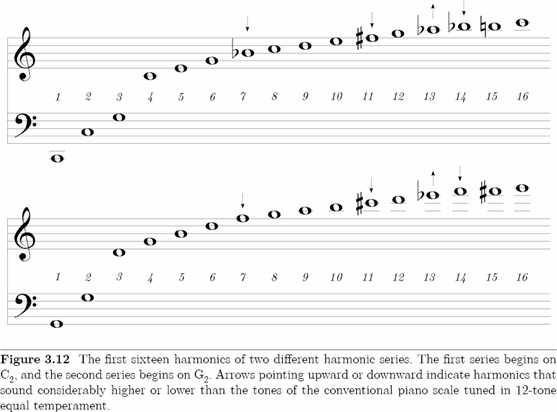
From my book Musical Mathematics: On the Art and Science of Acoustic Instruments (see Musical Mathematics Pages > Table of Contents), below please find Chapter 3, Figure 12, which illustrates the acoustic basis of just intonation in the context of the harmonic series.
Many modern music theorists have attempted to intellectually degrade the importance of just intoned scales by promulgating two serious misconceptions. First, they insist that in a musical context, the ratios of just intoned scales must include only simple or small integers. This bogus rule is based on the premise that the frequency ratios of just intonation are somehow synonymous with consonant tones and intervals like 2/1, 3/2, 4/3, etc. Almost four centuries ago, Mersenne observed, “. . . all the vibrations of air which the consonances and dissonances make are commensurable [rational] . . .” (Text in brackets mine.) Second, they insist that just intonation is a tuning system, or some specific scale. Any scale that includes interval ratios such as 7/5, 11/8, or 16/13 challenges both of these highly opinionated assumptions. First, such scales contradict the notion that interval ratios with prime numbers larger than 5 are inherently dissonant and musically unacceptable, and therefore serve no purpose in a just intoned scale. Second, it refutes the erroneous conclusion that a specific scale represents just intonation. Just intonation is not a tuning system. It is a tuning principle, or a method of tuning. Furthermore, a just intoned scale, like a tempered scale, may have any number of tones. All writers who applaud the “virtues” of tempered tunings while criticizing the “faults” of just intoned tunings argue their case from a very narrow perspective. Ultimately, such criticisms yield irrelevant bits of information, like the kind obtained from comparing apples and oranges.
Finally, with the exception of Western instruments influenced by keyboard and fretted instruments tuned in 12-tone equal temperament, most musicians in the world tune their instruments in just intonation, or based on intervals that have rational identities.