 Photo by Will Gullette |
| The spotted hawk swoops by and accuses me – 1986 Poem by Walt Whitman Music by Cris Forster Cris Forster, Harmonic/Melodic Canon and Voice |
| I am the poet of the Body – 2013 Poem by Walt Whitman Music by Cris Forster David Boyden, Harmonic/Melodic Canon and Voice |
| The past and present wilt & The spotted hawk swoops by and accuses me – 2013 Poems by Walt Whitman Music by Cris Forster David Boyden, Harmonic/Melodic Canon and Voice |
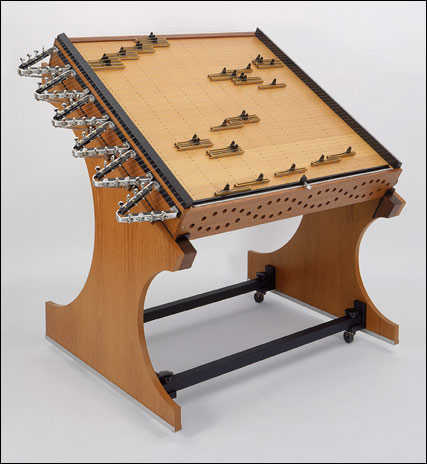
| Built: | 1976, San Diego, California. Wood construction. Sitka spruce soundboard with 48 dovetail tracks and 48 rosewood bridges. | |||
| Rebuilt: | • 1981. San Diego, California. Wood construction; new soundboard and new carriage bridges; original stand. • 1987. San Francisco, California. Wood, Delrin, and steel construction; new soundboard and original carriage bridges; new stand. | |||
| Modified: | • 2021. San Francisco, California. Remachined soundboard support posts and bracket hanger bolts. Machined new post brackets. | |||
| Dimensions: | Total number of strings: 48. String length + string compensation: 1000.0 mm + 2.0 mm × 2 = 1004.0 mm Canon length: 41½ in. Canon height: 5½ in. Canon width: 40½ in. Height on upper side: 51½ in. Height on lower side: 31¾ in. | |||
| Materials: | Sitka spruce, Honduras rosewood, birch, teak, Delrin, Kydex, E-A-R Isodamp thermoplastic, aluminum, and brass. Chromed cold-rolled steel and stainless steel. | |||
| Strings: | For Song of Myself. Music wire #10 — 0.024 in. Music wire #10 tension: 34.7 lbf | 15.7 kgf, except Strings 2–6 and 37–39. Open String 34, music wire #14 — 0.033 in. Open String 48, music wire #17 — 0.039 in. | |||
| Range: | For Song of Myself. With the exception of Strings 2–6, 34, 37–39, and 48, all open strings — before the placement of bridges — tuned to C3 (1/1) 130.0 cps. Highest bridged strings tuned to E5 (5/4) 650.0 cps. This constitutes a low-tension tuning suitable for playing the steel strings with the fingers. | |||
| Tuning: | Just Intonation. |
In ancient Greece, Pythagoras, Euclid, and Ptolemy used an instrument called the kanon to analyze and play many different kinds of intervals and scales. In Greek, the word kanon means (1) a straight rule or rod, as in measuring instrument; and (2) a general rule or principle, as in code of law.
On the Harmonic/Melodic Canon, all 48 strings are one meter long and are tuned to the same frequency, thereby giving an aural and mathematical constant. Moveable bridges then divide the strings into many different and exact length ratios, which in turn produce exact frequency ratios. Since the tuning possibilities on a canon seem endless, I refer to it as a “limited form of infinity.”
In the history of music, the Harmonic/Melodic Canon and the Bass Canon are the first canons that satisfy two musical conditions. Both canons have independently movable bridges that produce mathematically predictable length ratios; and both canons function as fully resonant performance instruments.
(See also Musical Mathematics Pages > Al-Jurjani’s Canon, > Forster’s Canon.)