 Photo by Cris Forster |
| Built: | 1978, San Francisco, California. | |
| 5-Bar Extension: | 1982, San Diego, California. | |
| Rebuilt: | 2019, San Francisco, California. With the exception of the original pernambuco bars, all new components based on Diamond Marimba II construction. | |
| Dimensions: | Total number of bars: 54. Longest bar length: 16¾ in. Shortest bar length: 6¼ in. Height to first row: 32½ in. Height to last row: 39½ in. | |
| Materials: | Pernambuco bars. 6 highest bars: Honduras rosewood. Birch, teak, maple, Delrin, cast acrylic, aluminum, and stainless steel. HR-23 foam supports. | |
| Range: | From G3 (1/1) 196.0 cps to Eb7 (13/8) 2548.0 cps. | |
| Tuning: | Just Intonation. |
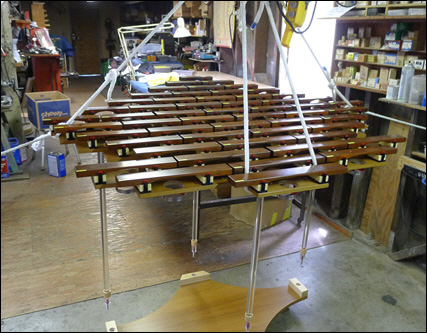
The photo above shows newly rebuilt Diamond Marimba I hanging from a hoist: the terraced platform with mounted pernambuco bars, but without resonators, is ready for lowering and fastening to the base.
I built my first Diamond Marimba in 1978 with pernambuco wood from Brazil. Due to excessive exploitation, high-density and quarter-sawn stock suitable for making marimba bars is no longer available. It is a great sorrow that distribution and sales of this highly resonant wood has been largely controlled by bow makers, whose end product makes no sound whatsoever.
Due to many experiments with the terraced platform that holds the bars and resonators, and with bar mounting components, it occurred to me that the original Diamond Marimba would probably not survive beyond my lifetime.
So, in an attempt to save this precious and irreplaceable wood, I decided the best chance for survival would be to completely rebuild this instrument.
In 1978, I made the six highest bars too small. Because I was unable to find suitable pernambuco stock for the rebuild, I replaced these bars with Honduras rosewood. Since all the original smallest bars produce a bright and clear tone, I matched the sonic properties of the new Honduras rosewood bars to the old pernambuco bars.
I rebuilt Diamond Marimba I with exactly the same bar-mounting parts and materials installed on Diamond Marimba II. This provided me with a scientific basis on which to compare the timbres, amplitudes, and ring-times of the lower 48 pernambuco bars of Diamond Marimba I to the lower 48 Honduras rosewood bars of Diamond Marimba II. I can now unequivocally report that high-quality pernambuco bars are in all respects comparable to high-quality Honduras rosewood bars. In other words, Honduras rosewood is not exclusively the best wood for making marimbas. Pernambuco bars sound just as good!
Diamond Marimba I has 11 rows of 48 pernambuco bars, and 3 rows of 6 Honduras rosewood bars — or a total number of 14 rows — mounted on a terraced platform. Beginning with the second row, each succeeding row rises by 0.54 in. above the previous row, so that the difference in height between the first and the last row equals 7.0 in. Each bar is equipped with a tuned cast acrylic tube resonator that amplifies the frequency of the bar.
The marimba’s central section consists of a diamond-shaped lattice that includes seven ascending and seven descending diagonals of bars. Each diagonal includes seven bars. Diagonals that ascend from left to right sound major tonalities, and diagonals that descend from left to right sound minor tonalities.
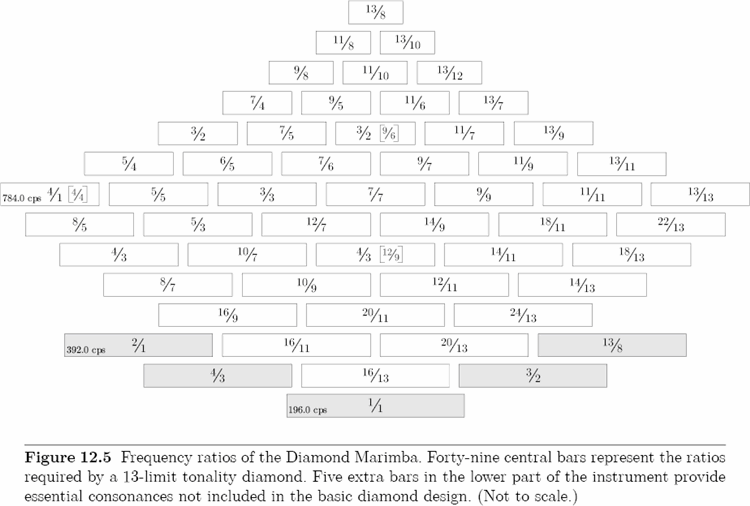
From my book Musical Mathematics: On the Art and Science of Acoustic Instruments (see Musical Mathematics Pages > Table of Contents), below please find Figure 12.5, which illustrates the frequency ratios of Diamond Marimba I and Diamond Marimba II. The tunings of the fundamental frequencies of both Diamond Marimbas are identical. Regarding the tuning of the higher modes of vibration of bars, see Creative Aspects > Instrument Design Features.
(See also Musical Mathematics Pages > Meyer’s Diamond, > Partch’s Diamond, > Forster’s Diamond.)