 Photo by Will Gullette |
ON THE ART AND SCIENCE OF ACOUSTIC INSTRUMENTS
© 2000–2025 Cris Forster
CHAPTER 13: BUILDING A LITTLE CANON
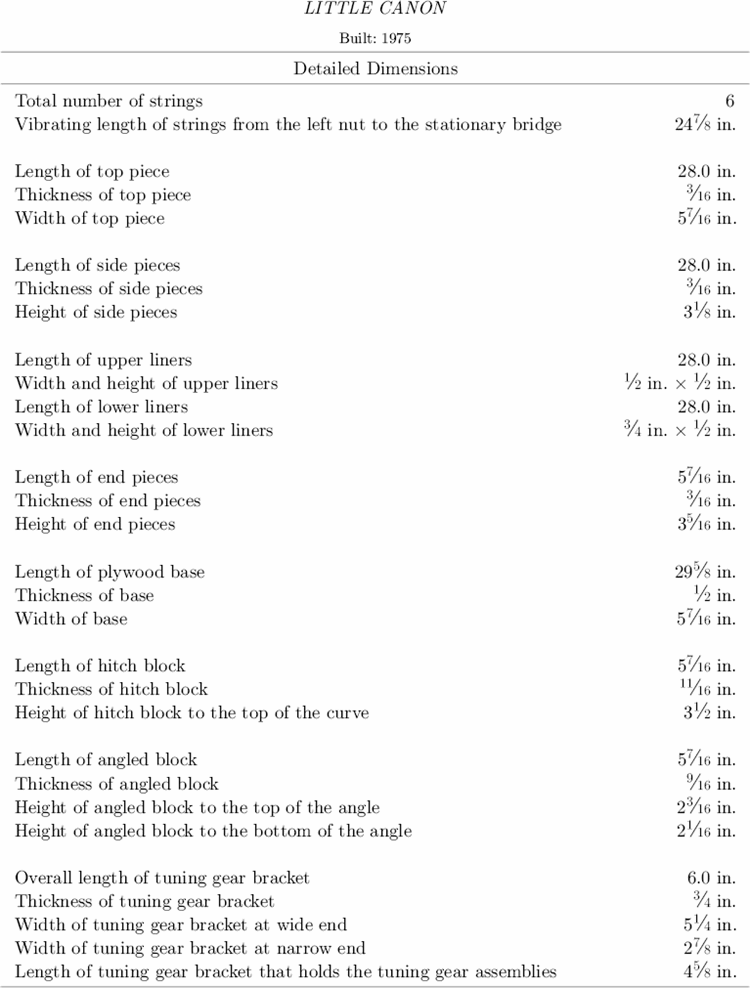
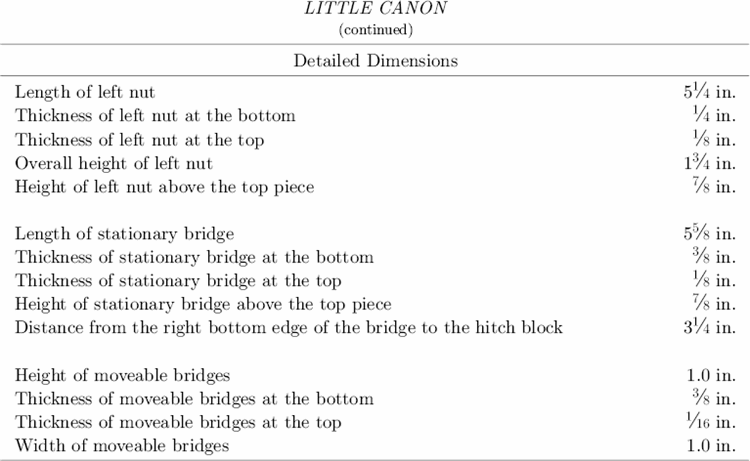
Parts, Materials, Labor, and Detailed Dimensions
The Little Canon in Plate 12 is the first musical instrument I built. Since a small canon is not too difficult to make, the following description may inspire some readers to build such an instrument, and to verify for themselves which intervals and scales sound consonant, and which sound dissonant.
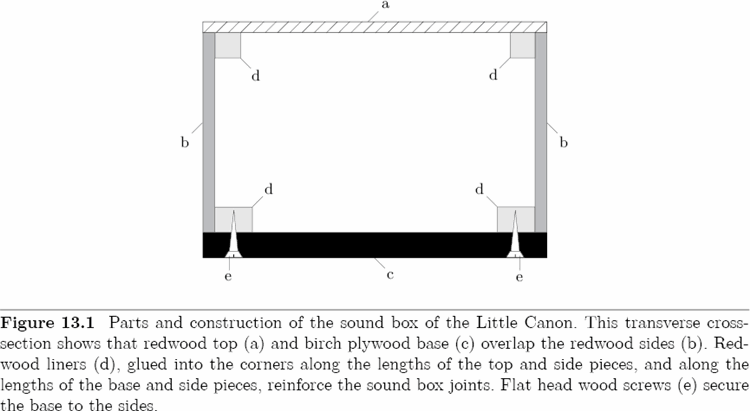
The Little Canon consists of a long rectangular sound box equipped with six strings. Figure 13.1 shows a transverse cross-section of the sound box. The top (a) and two sides (b) are redwood. Clear kiln-dried redwood is fairly resonant and, in Northern California, is easily obtained in many different dimensions. However, Sitka spruce works just as well, and produces a better tone. The bottom (c) is birch plywood. Plate 12 does not reveal the layers of the plywood bottom because I veneered the exterior edge with birch veneer. A rigid bottom is very important because it prevents the instrument from bending and twisting out of shape after the strings are tensioned. Also in Figure 13.1, note that the top and bottom pieces overlap the side pieces. This design ensures that the top and bottom provide flat gluing surfaces. Now, in the corners along the entire lengths of the top and side pieces, and along the entire lengths of the bottom and side pieces, redwood liners (d) reinforce the sound box joints and strengthen the instrument as a whole. First, I glued the upper and lower liners to the sides. Next, I used flat head wood screws (e) and glue to secure the bottom to the sides. Finally, I fastened the top to the sides.
Turn to Figure 13.2, which shows a longitudinal cross-section of the Little Canon. To close the structure, notice that I glued redwood end pieces (a) to the top and sides at the ends of the sound box. However, observe carefully that the plywood bottom (b) extends beyond the two end pieces. Flat head wood screws secure a rounded beech hitch block (c) to the bottom at the right end, and a short angled birch block (d) to the bottom at the left end of the instrument. I also glued these two blocks to the end pieces. Plate 12 shows that the hitch block on the right has six holes for threading and fastening the ends of the strings. The angled block on the left supports a birch tuning gear bracket (e). Four oval head wood screws secure the tuning gear bracket to the angled block. Also, note that I cut two long slots into the bracket. I then drilled three holes that pass through the front edge, the front slot, and into the body of the bracket; similarly, three holes pass through the back edge, the back slot, and into the body of the bracket. Next, I inserted three nylon posts of a tuning gear assembly (f) through the front holes, and three nylon posts of a tuning gear assembly through the back holes. Four screws hold each assembly in place. Three strings enter each slot and wind around the nylon posts to tension the strings.
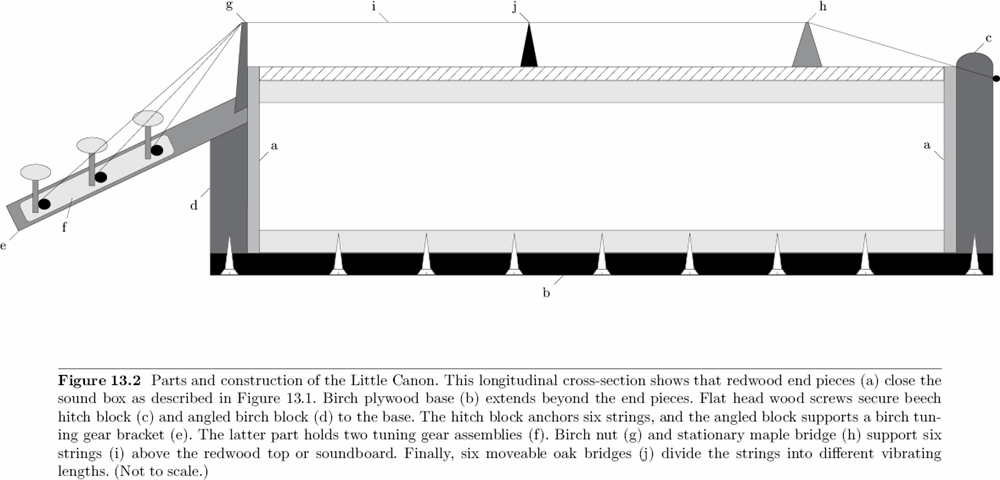
Plate 12 and Figure 13.2 show that a birch nut (g) and a stationary maple bridge (h) support six strings (i). The nut and bridge have hard rosewood caps to prevent the strings from cutting into these parts. I glued the nut into an angled slot in the tuning gear bracket and against the left end piece; and I epoxied the bridge on the top near the hitch block. Both components have a height of 7/8 in. above the redwood top or soundboard so that the strings run parallel to the surface of the soundboard. Finally, six moveable oak bridges (j) divide the strings into different vibrating lengths.
With respect to materials, there are two basic kinds of wood: softwoods and hardwoods. Spruce and redwood are domestic softwoods; birch, beech, maple, and oak are domestic hardwoods. Rosewood is a tropical hardwood with a weight density greater than water, which means it does not float. (See Appendices E and G.) For the sound box and liners, it is important to use clear kiln-dried redwood or spruce. However, for the rest of the instrument, all domestic hardwoods work equally well. I used four different hardwoods simply because they were available to me.
I strongly recommend yellow woodworking glue called aliphatic resin glue, and two-part clear epoxy. Do not use white glue or hide glue. Also, I no longer use wood screws. The tapered shanks and shallow threads of these screws do not cut into the fibers of the wood very well. Instead, I use sheet metal screws (also called tapping screws) in wood. These screws have cylindrical shanks and extremely sharp and deep threads.
The lengths of commercial acoustic guitar strings determine the distance of the Little Canon from the furthest tuning gear posts to the hitch block. Since this instrument requires six identical strings, one must buy six identical sets of guitar strings because all the strings in a single set have different diameters. Readers interested in building large canons with long strings must make their own strings. Piano supply houses and some local piano technicians sell high-carbon spring steel music wire in 1 lb. rolls. However, piano wires do not work for making canon strings because the diameters are too thick and, therefore, require too much tension to produce a good tone. See Appendix D for ordering thin steel music wire sizes with diameters in the 0.016–0.024 in. range. Also, tuning gears equipped with long nylon posts are available from local guitar shops.
Readers who would like to own a small canon but are not inclined to build one must hire a woodworker. A professional should require approximately 10 hours to build such an instrument. The sound box is the most time-consuming task. First, thick boards must be either resawn or surface planed to make the thin top, side, and end pieces. Then the liners must be glued to the inside surfaces of the sides before the sound box can be assembled. While the glue is drying, all the other parts can be made. To minimize labor charges, the reader should have the tuning gears and strings available for measuring before the building begins.
In conclusion, according to Equation 2.10, a steel string with a fundamental frequency of middle C (or C4 at 261.63 cps), a vibrating length of 24 7/8 in., and a diameter of 0.022 in. has a tension of 47.21 lbf; six such strings produce 283.26 lbf. This total force is well within the structural limitations of the Little Canon.