ON THE ART AND SCIENCE OF ACOUSTIC INSTRUMENTS
© 2000–2025 Cris Forster
CHAPTER 10: WESTERN TUNING THEORY AND PRACTICE
Part VI: Just Intonation
Section 10.67
Harry Partch (1901–1974), who stated, “I am not an instrument-maker, but a philosophical music-man seduced into carpentry,” spent his entire adult life building a unique collection of acoustic musical instruments, composing music for these instruments, and writing about the significance of just intonation. In 1949, Partch published a book entitled Genesis of a Music,[1] in which he passionately advocated the musical incorporation of prime numbers 7 and 11. An expanded second edition of this work appeared in 1974.[2] Despite Partch’s attempt to recognize Max F. Meyer’s “. . . salutary effect . . . [on the] . . . presentation of material . . .”[3] in Genesis of a Music, Partch failed to acknowledge Meyer as the creator of the 7-limit Tonality Diamond, and thereby plagiarized his work. (See The Partch Hoax Doctrines.) In both editions of Genesis, Partch included four illustrations based on Meyer’s tonality diamond: a 5-limit Incipient Tonality Diamond, an 11-limit Expanded Tonality Diamond, an 11-limit Block Plan of the Diamond Marimba, and The Tonality Diamond on a 13-Limit.[4] With respect to his Diamond Marimba, Partch states
This instrument is the theoretical Tonality Diamond brought to practical tonal life . . .[5]
A comparison to Figure 10.57(b) reveals that Partch’s marimba pattern introduced three minor changes into Meyer’s original design. Refer to Figure 10.59, which shows an exact copy of Partch’s block plan, and note that Partch (1) rotated Meyer’s tonality diamond 180 degrees on its vertical axis, (2) reversed the locations of prime number 3 and 5, and (3) added four new diagonals. The first modification left Meyer’s tonality diamond intact and only changed the directions of the major and minor tonalities: they now ascend and descend from left to right. The need for the second change has already been discussed in Section 10.65.
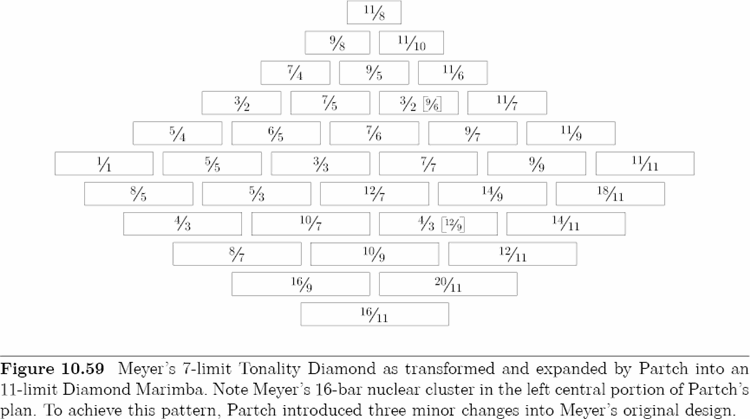
The third alteration added 20 bars to Meyer’s 7-limit nuclear cluster, and enabled Partch to play six major chords with just ninths and just elevenths in an ascending direction and, conversely, six minor chords with just ninths and just elevenths in a descending direction.
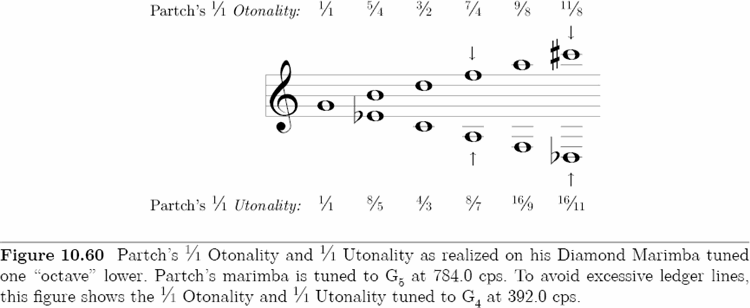
We may interpret the frequency ratios of Partch’s Diamond Marimba in the following manner. If we think of 1/1 as the fourth harmonic, then the ascending sequence of tones — 1/1, 5/4, 3/2, 7/4, 9/8, 11/16 — represents the 4th, 5th, 6th, 7th, 9th, 11th harmonics of the harmonic series, respectively; and the descending sequence of tones — 1/1, 8/5, 4/3, 8/7, 16/9, 16/11 — represents the exact inversion of the ascending sequence. Partch referred to the former sequence as a 1/1 Otonality, which means that the major tonality progresses in an ascending direction “over” 1/1; and he referred to the latter sequence as a 1/1 Utonality, which means that the minor tonality progresses in a descending direction “under” 1/1. Similarly, the 11-limit Diamond Marimba also consists of 8/5–, 4/3–, 8/7–, 16/9–, 16/11 Otonalities, and 5/4–, 3/2–, 7/4–, 9/8–, 11/8 Utonalities. However, it is important to point out that for Partch, “. . . neither overtones [harmonics] nor undertones [subharmonics] are predicated as determinants of Monophony’s tonalities; these are implicit in small-number ratios.”[6] (Text in brackets mine.) In other words, Partch maintained that his musical thinking is not indebted to modern discoveries in acoustics. He thereby renounces all ties to the recent past and claims that his musical theories are solely based on the ancient Greek method of dividing canon strings.
On Partch’s Diamond Marimba, the neutral axis that runs through the center of the diamond — 1/1, 5/5, 3/3, 7/7, 9/9, 11/11 — sounds G5 at 784.0 cps. If we lower this central pitch by one “octave” to G4 at 392.0 cps, Figure 10.60 shows the approximate tones of the 1/1 Otonality and the 1/1 Utonality on the conventional treble staff. As in Chapter 3, Figure 12, arrows pointing downward indicate tones that sound considerably lower than notated, and arrows pointing upward indicate tones that sound considerably higher than notated.
Regarding the debate over generator vs. fundamental, recall Rameau’s passage in Section 10.63, Quote VIII, which states that the fundamental of the minor triad is the lowest sounding note. Partch essentially agreed with Rameau’s interpretation when he noted
In Utonality (“minor”) the conception is somewhat different, since the series of identities descends in pitch from its unity [that is, descends from the “generator,” ratio 1/1, or from the “octave,” ratio 2/1], though the practical results are exactly the same; the unity is here the “fifth of the chord” [that is, the “octave” sounds the interval of a “fifth” above 4/3, or 2/1 ÷ 3/2 = 4/3]. The long controversy as to the correct location of the “root” of the “minor” triad is rhetoric, so far as creative music goes, since the composer needs no greater authority than his fancy to put the “root” wherever he wants to put it. In the final chord of a cadence it is quite natural to put the . . . (“root”) at the bottom, since the natural position of the unity in the Tonality Diamond is at the top.[7] (Text and ratios in brackets mine. Text in parentheses in Partch’s original text.)
[1]Partch, H. (1949). Genesis of a Music. The University of Wisconsin Press, Madison, Wisconsin.
[2]Partch, H. (1949). Genesis of a Music, 2nd ed. Da Capo Press, New York, 1974.
[3]Genesis of a Music (1949), p. 300. Genesis of a Music (1974), p. 427.
[4]Genesis of a Music (1949), p. 110, 158, 213, and 327, respectively. Genesis of a Music (1974), p. 110, 159, 261, and 454, respectively.
[5]Genesis of a Music (1974), pp. 259–261.
[6]Ibid., p. 75
Partch referred to his general system of tuning as Monophony, and gives the following definition on p. 71: “Monophony: an organization of musical materials based upon the faculty of the human ear to perceive all intervals and to deduce all principles of musical relationships as an expansion from unity, as 1 is to 1, or – as it is expressed in this work – 1/1.” Compare this statement to Zarlino’s definition of Unità in Section 10.59: “According to Unity, each thing, be it simple or compound, or corporeal or spiritual, is characterized by oneness.”
[7]Ibid., p. 112.