ON THE ART AND SCIENCE OF ACOUSTIC INSTRUMENTS
© 2000–2025 Cris Forster
CHAPTER 10: WESTERN TUNING THEORY AND PRACTICE
Part VI: Just Intonation
Section 10.65
In 1929, one hundred and seventy-nine years after the appearance of Rameau’s Démonstration, German-born American psychologist Max F. Meyer (1873–1967) published a volume entitled The Musician’s Arithmetic.[1] Meyer wrote this book as a primer in mathematics for music students.
The great practical problem for the student of “a musician’s arithmetic” consists in learning to talk of ratios whose terms contain the prime numbers 1, 3, 5, and 7 . . . as factors, in the numerators and denominators of the fractions expressing the ratios. (“2” is omitted from the list of prime numbers because . . . in “discovering the octave” we have dispossessed ourselves of all even numbers; “11” is omitted because a prime number as large as that is unlikely to be needed, but whoever wants an intellectual chastisement may put it back.)
The student cannot talk intelligently of ratios unless they mean something to his ear. Unfortunately he has never met a teacher (have you met one?) capable of training him to connect melodic phrases with ratios of numbers.[2]
Throughout his text, Meyer is extremely critical of Rameau’s theories. He finds Rameau’s conclusion “. . . that there are only two modes, the major and the minor . . .”[3] particularly offensive and damaging to the future development of music:
Rameau’s mistake in substituting two modes for the ancient seven modes was an error of over-emphasis . . . His mistake has resulted in denying to the composer the freedom of further inventions, and has thus hampered musical progress.[4]
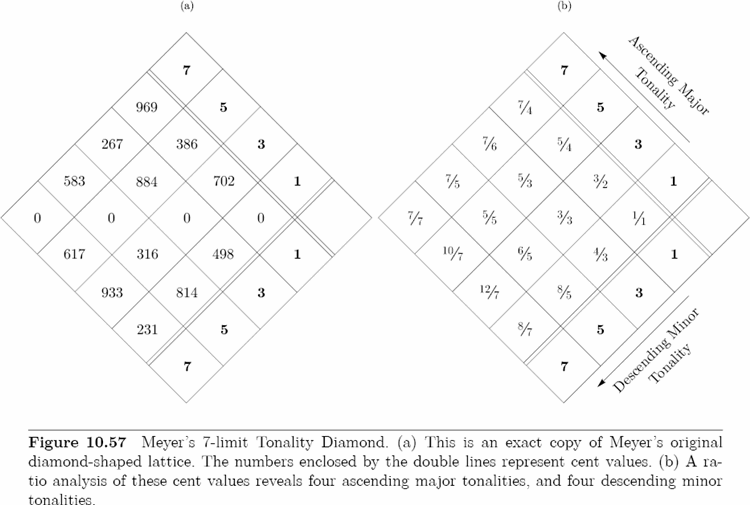
Despite such criticisms, there are many indications that Rameau had a considerable influence on Meyer’s understanding of musical mathematics. For example, Meyer’s highly original illustration on p. 22 of his book shows a mathematical and musical structure that would have been unthinkable without knowledge of Rameau’s Génération harmonique. Figure 10.57(a) is an exact copy of Meyer’s illustration. Notice immediately that this figure is remarkably similar to Al-Jurjani’s triangular table in La Musique Arabe, Volume 3, p. 230, and to Salinas’ engraving in Figure 10.46. All three figures consist of diamond-shaped tiles organized into a two-dimensional pattern of just intoned ratios. In Meyer’s figure, evidence of just ratios is not immediately apparent because, with the exception of integers 1, 3, 5, 7, all other numbers represent cent values. However, the ratio analysis in Figure 10.57(b) reveals that these cent values indicate four ascending major tonalities, and four descending minor tonalities.
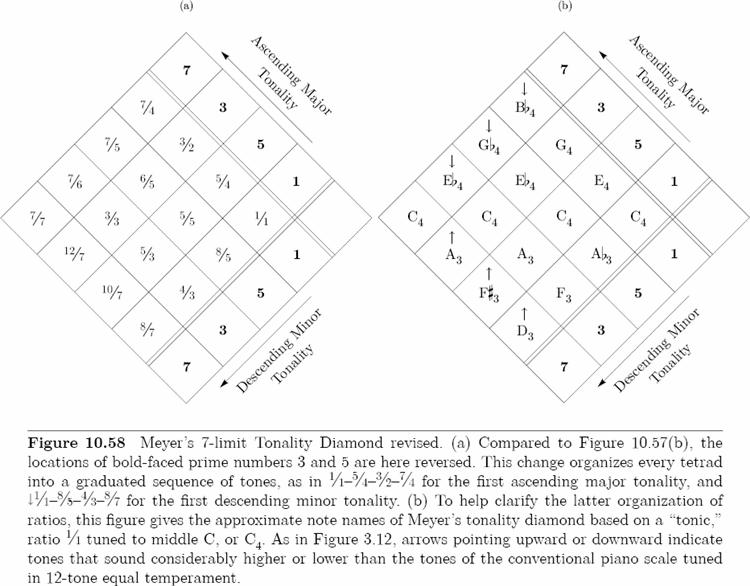
As was the custom for Rameau (see Section 10.61, Quotes IV and V), so Meyer also used a shorthand notation that consisted of simple integers. For example, integers 1–3–5–7 represent frequency ratios 1/1, 3/2, 5/4, 7/4, respectively. Furthermore, Meyer expressly stated that “. . . a dash between two numbers will always mean an interval — or ‘span,’ as we call it, — between the two tones represented by the two numbers.”[5] Although such an ordered sequence of integers is numerically appealing, it does not express a graduated progression of intervals: here a large “fifth,” ratio 3/2, is followed by a small “major third,” ratio 5/4, which in turn is followed by an even larger “minor seventh,” ratio 7/4. Therefore, I decided to reverse the order of prime numbers 3 and 5, resulting in the sequence: 1–5–3–7. Figure 10.58(a) shows that without changing the contents of the diagonals, every tetrad now expresses the graduated sequence: “tonic,” “major third,” “fifth,” “minor seventh.” To help clarify these ascending and descending relations, Figure 10.58(b) gives the approximate note names of Meyer’s tonality diamond based on a “tonic,” ratio 1/1, tuned to middle C, or C4.
We may arrange the thirteen unique frequency ratios of Meyer’s 7-limit Tonality Diamond — plus the “octave,” ratio 2/1 — into the following scale, which contains three kinds of “thirds,” two kinds of “tritones,” and three kinds of “sixths”:

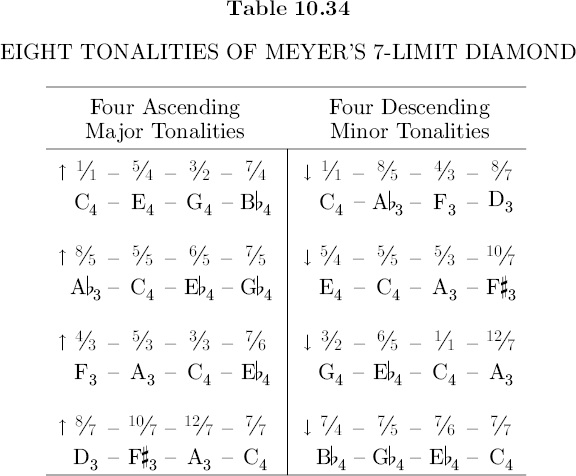
The musical organization of Meyer’s tonality diamond is based on Rameau’s theory of a dual-generator. In other words, in Figure 10.58, pitch C4 generates the first ascending major tonality C4–E4–G4–Bb4, expressed as ratios 1/1–5/4–3/2–7/4, and pitch C4 generates the first descending minor tonality ↓C4–Ab3–F3–D3, expressed as ratios ↓1/1–8/5–4/3–8/7. Turn now to Table 10.34, which lists the exact ratios and approximate note names of Meyer’s 7-limit Tonality Diamond. Here the left column lists four ascending diagonals that constitute four ascending major tonalitites, and the right column, four descending diagonals that constitute four descending minor tonalitites. Observe that since the first interval of the first ascending diagonal consists of an ascending “major third,” 1/1 × 5/4 = 5/4, or interval C4–E4, the first interval of the first descending diagonal sounds a descending “major third,” 2/1 ÷ 5/4 = 8/5, or interval ↓C4–Ab3. Consequently, the latter pitch Ab3, ratio 8/5, acts as the first tone of the second ascending major tonality Ab3–C4–Eb4–Gb4. Similarly, since the second interval of the first ascending diagonal consists of an ascending “fifth,” 1/1 × 3/2 = 3/2, or interval C4–G4, the second interval of the first descending diagonal sounds a descending “fifth,” 2/1 ÷ 3/2 = 4/3, or interval ↓C4–F3. Consequently, the latter pitch F3, ratio 4/3, acts as the first tone of the third ascending major tonality F3–A3–C4–Eb4. Finally, since the third interval of the first ascending diagonal consists of an ascending “minor seventh,” 1/1 × 7/4 = 7/4, or interval C4–Bb4, the third interval of the first descending diagonal sounds a descending “minor seventh,” 2/1 ÷ 7/4 = 8/7, or interval ↓C4–D3. Consequently, the latter pitch D3, ratio 8/7, acts as the first tone of the fourth ascending major tonality D3–F#3–A3–C4.
With respect to the second column in Table 10.34, observe that E4, or the “major third” of the first ascending diagonal, acts as the first tone of the second descending minor tonality ↓E4–C4–A3–F#3; similarly, G4, or the “fifth” of the first ascending diagonal acts as the first tone of the third descending minor tonality ↓G4–Eb4–C4–A3; and finally, Bb4, or the “minor seventh” of the first ascending diagonal acts as the first tone of the fourth descending minor tonality ↓Bb4–Gb4–Eb4–C4.
Finally, and most importantly to composers and musicians, the tonality diamond furthers the study of just intonation because its unique lattice design of crisscrossed diagonals reveals that every ratio may be taken in two different senses. In this respect, the diamond pattern sheds new light on the Western practice of modulation. Students of traditional harmony learn that modulation from one key to another key — say, from C-major to Bb-major — requires a transitional chord that both keys have in common; in this case, an F-major triad qualifies because it represents the chord of the subdominant in C-major, and the chord of the dominant in Bb-major. Similarly, every just ratio in Meyer’s tonality diamond serves a double function. For example, Eb4, ratio 6/5, functions as a “major third,” ratio 5/4, in the descending minor tonality that begins on G4, ratio 3/2; and Eb4 also functions as a “fifth,” ratio 3/2, in the ascending major tonality that begins on Ab3, ratio 8/5.
On many occasions, Meyer refers to his tonality diamond as a “table of spans.” It is his single most important teaching tool. Meyer uses the diamond not only for convenient interval calculations, but also as a musical mandala designed to symbolize myriad mathematical possibilities of just intoned harmonies and scales. Toward the end of his book, Meyer acknowledges Rameau’s contributions, and offers his own thoughts on the importance of just ratios in the study of music:
Rameau and beyond Rameau. Rameau brought a certain clearness into the theory of chords by giving each tone an absolute name (fundamental, third, fifth, etc.) in the chord without any reference to the actual intervals. This reference to the actual intervals, he discovered, could be avoided by using the concept of the inversion of chords . . .
The limits of this clarifying influence of Rameau we recognized when we studied his “theorem.” It is only by substituting number symbols for such terms as Rameau’s “fundamental, third, fifth, seventh, etc., natural, diminished, augmented” that we can free the theory from artificial fetters . . .
The number symbol has the advantage over all other terms that it is both absolute and relative . . . Only number symbols can simply and directly and without modifying epithets fulfill this double condition. All other names force us to use queer modifiers like “augmented, sharpened,” or what not, of little definiteness.
A number is always absolute, individual, in being distinct from all other numbers. And it is always relative because it permits and invites the formation of a ratio. And there is no lower nor upper limit to the quantity of terms which may enter a ratio, — two, three, four, five, any multitude. The crazy concept of a “triad” as the only legitimate tone family, outlawing all smaller and larger families as being of illegal size, is safely avoided. For examples compare in the body of our text our numerous “scales” varying in size from two [tones and] up.
Ratios, when reduced to their lowest terms or translated into “spans” are quickly comparable with other ratios without any possibility of ambiguity. No other terms are safe from ambiguity.[6] (Bold italics, and text in brackets mine. Text in parentheses in Meyer’s original text.)
We conclude, therefore, that Meyer considered the four diagonal lines that enclose his tonality diamond as moveable boundaries, and that he did not rigidly limit the musical possibilities of just intoned frequency ratios to prime numbers 2, 3, 5, and 7.
[1]Meyer, M.F. (1929). The Musician’s Arithmetic. Oliver Ditson Company, Boston, Massachusetts.
Under the mentorship of renowned physicist Max Planck (1858–1947), and distinguished acoustician Carl Stumpf (1848–1936), Max F. Meyer received his Ph.D. from the University of Berlin in 1896 at the age of twenty-three. With the approval of Planck and Stumpf, Meyer’s dissertation, Über Kombinationstöne und einige hierzu in Beziehung stehende akustische Erscheinungen, which describes a mathematically based theory of hearing, was published in the same year. In 1900, Meyer founded the Psychology Department at the University of Missouri, and held the position as Professor of Experimental Psychology until 1929.
[2]Ibid., p. 20.
[3]Hayes, D., Translator (1968). Rameau’s Theory of Harmonic Generation; An Annotated Translation and Commentary of “Génération harmonique” by Jean-Philippe Rameau, pp. 163–164. Ph.D. dissertation printed and distributed by University Microfilms, Inc., Ann Arbor, Michigan.
[4]The Musician’s Arithmetic, p. 51.
[5]Ibid., p. 6.
[6]Ibid., pp. 103–105.